Serial work: what each tool documents about continuity
What Vidu gives you for a whole season
Vidu (platform.vidu.com) documents supplying one to seven reference images on each call so the model generates a video with consistent subjects. Nothing in the documentation describes a character or element stored between calls. As of 2026-09-12.
Fig. 1 Filled where the tool publishes a mechanism for that step, hollow where it publishes nothing on it.
The three season-scale steps, for Vidu. Read from the vendor's reference-to-video API reference on 2026-09-12.
Inclusion rule. The same three steps are recorded for every tool here. A step the vendor does not publish is recorded as nothing published rather than inferred from the interface. Order. Fixed step order, identical on every tool page.
Fig. 2 One step at a time, every tool side by side, Vidu marked. Hollow means the vendor publishes nothing on that step, not that the tool cannot do it. Wording in the rows below. Rows read between 2026-09-12 and 2026-09-22.
Every tool on one step, with Vidu marked. Rows read between 2026-09-12 and 2026-09-22.
Inclusion rule. Tools whose public pages describe at least one of the three season-scale steps. A tool silent on this particular step keeps its row, marked hollow. Order. Alphabetical by tool name.
Fig. 3 One step at a time, every tool side by side, Vidu marked. Hollow means the vendor publishes nothing on that step, not that the tool cannot do it. Wording in the rows below. Rows read between 2026-09-12 and 2026-09-22.
Every tool on one step, with Vidu marked. Rows read between 2026-09-12 and 2026-09-22.
Inclusion rule. Tools whose public pages describe at least one of the three season-scale steps. A tool silent on this particular step keeps its row, marked hollow. Order. Alphabetical by tool name.
Fig. 4 One step at a time, every tool side by side, Vidu marked. Hollow means the vendor publishes nothing on that step, not that the tool cannot do it. Wording in the rows below. Rows read between 2026-09-12 and 2026-09-22.
Every tool on one step, with Vidu marked. Rows read between 2026-09-12 and 2026-09-22.
Inclusion rule. Tools whose public pages describe at least one of the three season-scale steps. A tool silent on this particular step keeps its row, marked hollow. Order. Alphabetical by tool name.
2Consistency inside a call is a different promise from consistency across a series
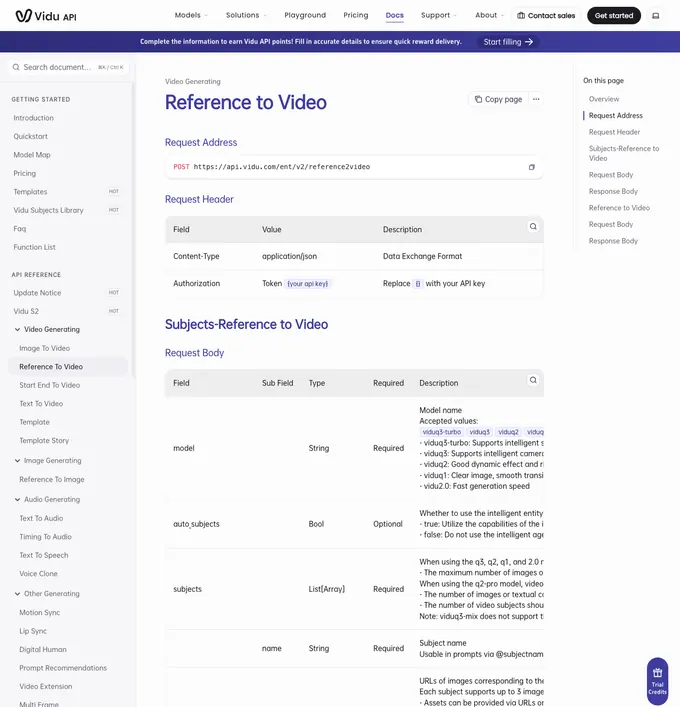
Seven reference images is a lot of material to characterise a subject with, and the documentation is explicit about what they are for. What it does not describe is any object that survives the call: the next generation starts from whatever images are supplied to it.
For a single scene that is sufficient and arguably cleaner than a stored object, because nothing can drift invisibly. For forty episodes it means the reference set is a production asset somebody has to keep, version and attach correctly every time.
Fig. 5 An API reference, which is where the per-call reference limit and the statement that nothing is stored between calls both sit.Screenshot of platform.vidu.com/docs/reference-to-video, captured 2026-09-16. Reproduced to show where this entry was read from.
3The register keeps per-call and per-character apart on purpose
Two other tools here define a reusable element that carries appearance between generations. One supplies a reference clip per call. This one supplies reference images per call. Those are three mechanisms, and the column would be useless if all three collapsed into a yes.
Nothing published ranks them for output quality, and this register does not either. What it records is where the state lives, because that is what decides whose job it is to keep it.
4Published limits, which most of this register lacks
Reference images at least 128x128, aspect ratio inside 1:4 to 4:1, durations from 1 to 16 seconds depending on model. Those are exact figures on an API reference, which is the most precise material in this register and also the material written for developers rather than producers.
Nothing addresses episodes, seasons or assembly, which is consistent with an API product: those layers belong to whoever is calling it.
Each reading below takes one column, quotes the sentence this vendor published on it, and says what the sentence declines to settle.
Vidu on the cast — The API reference takes up to seven reference images per request and documents no stored character, so the filing of a cast sits with the caller.
Read from the reference-to-video API reference at platform.vidu.com, checked 2026-09-12. Every tool on the same three steps is in the register; what counts as published is on how read.
Cross-episode cast
One to seven reference images per call, used so the model generates a video with consistent subjectsper call rather than per characterVidu, reference-to-video API reference/ recorded 2026-09-12
Cross-episode cast
No reusable character or element stored between calls is documentedwhat the documentation does not describeVidu, reference-to-video API reference/ recorded 2026-09-12
Stated limits on the inputs and the output
Reference images must be at least 128x128, with an aspect ratio inside 1:4 to 4:1; durations run 1 to 16 seconds depending on modelVidu, reference-to-video API reference/ recorded 2026-09-12